

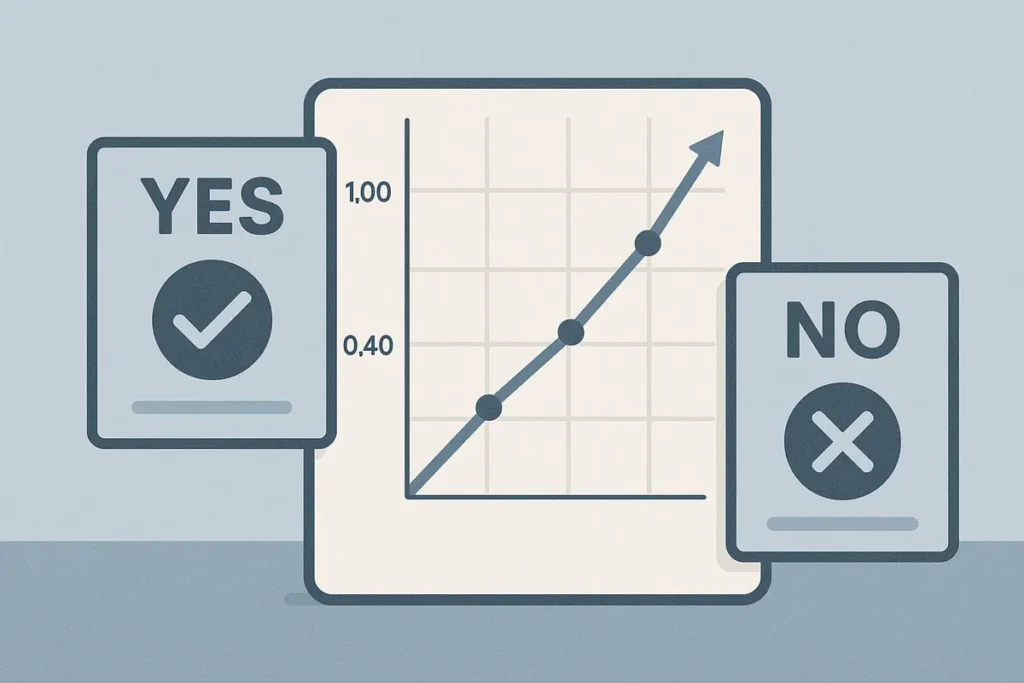
What are prediction markets?
Ever stared at a sportsbook and thought, why can’t I just take a position on whether the Fed cuts rates, or whether it rains in Mumbai next Tuesday? That question is basically the whole pitch for prediction markets.
A prediction market is a venue where people buy and sell contracts tied to the outcome of a real-world event, and the price of each contract moves with the crowd’s estimate of how likely that outcome is. If a contract on “Candidate A wins” trades at 62 cents, the market is collectively saying the chance is about 62%. When the event resolves, the contract is worth either 100 cents or nothing.
That’s the core idea. Traders are not betting against a house that sets the line; they’re trading with each other, and the platform takes fees or earns on the spread. Everything else, the platforms, the legal fights, the strange resemblance to a betting slip, follows from that structure.
Following one contract from listing to settlement
The fastest way to understand this is to walk a single contract all the way through. Say a platform lists a market titled: “Will the national rainfall total for July exceed the long-term average?” Two contracts exist, YES and NO, and their prices always add up to roughly 100 cents.
Contract types and pricing
Most prediction markets trade binary event contracts. You either get paid a fixed amount if the stated condition happens, or you get nothing. The price is the interesting part, because it is simultaneously the cost of entry and the market’s implied probability.
Suppose YES is trading at 40 cents. You buy 100 YES contracts:
- Cost: 100 × $0.40 = $40. That $40 is your maximum loss.
- If the condition is met: each contract settles at $1, so you receive $100, a $60 profit.
- If it isn’t met: the contracts settle at zero and the $40 is gone.
Now translate that into language a bettor already speaks. A 40-cent price implies a 40% chance, which is the same as decimal odds of 2.50 (1 ÷ 0.40). Risking $40 to win $60 is 3/2 in fractional terms. Same maths, different clothing. That’s why sports traders pick this up quickly.
Two things make prediction markets behave unlike a fixed-odds slip. First, you don’t have to wait. If heavy monsoon forecasts push YES from 40 to 65 cents, you can sell your position for $65 and bank $25 before the month even ends, or cut it at 25 cents and limit the damage. Second, you can take the other side. Buying NO is functionally the same as laying the outcome on a betting exchange.
Liquidity decides how pleasant any of this is. Busy markets on major elections or big sporting events have tight spreads and real depth, so a modest order barely moves the price. Obscure markets can show a 10-cent gap between the best buy and sell price, and that gap is a real cost you pay on entry and again on exit. Some platforms use professional market makers to keep quotes on the screen; others rely purely on an order book of users. Check the spread and the volume before you assume a price is “fair”.
How prediction contracts settle
Settlement is where beginners get burned, so read the rules before you trade, not after. Each market publishes a resolution source and a precise definition of what counts as a win. For a weather contract, that might be a named meteorological department’s official monthly figure, published on a specific date. Not a news headline. Not your own reading of a radar map.
Once the resolution source reports, the market resolves. YES holders get $1 per contract, NO holders get nothing, or the reverse. On regulated venues, the exchange itself determines settlement against the stated source and can void or extend a market if the source fails to report. On crypto-native platforms, resolution is typically handled by a decentralised oracle, where token holders effectively vote on the reported outcome and disputes can be escalated. Either way, the edge cases matter: what happens if an election is contested, a match is abandoned, or a data release is delayed? Good markets spell that out in the rules tab. Skim it.
The ambiguity that trips people up is almost always wording. “Will X be announced by December 31?” and “Will X happen by December 31?” are different contracts, and traders have lost money on the difference.
The main prediction market platforms
A handful of venues dominate the conversation, and they are not interchangeable.
- Kalshi operates as a federally regulated designated contract market in the United States, overseen by the Commodity Futures Trading Commission. Its markets span economics, politics, weather, culture and, more recently and controversially, sports outcomes. Everything is dollar-denominated and settlement is handled by the exchange.
- Polymarket is the crypto-native heavyweight, with positions funded in stablecoins and resolution handled on-chain. Its catalogue is broad and fast-moving, from elections to geopolitics to entertainment, and its user base is global rather than US-centric.
- PredictIt is the long-running political market with an academic research lineage, operating in the US under a narrow arrangement with the CFTC. It’s small by design, with caps on positions, and it built its reputation on election forecasting rather than volume.
Beyond those three, brokerages and crypto exchanges have moved in. Connecticut’s 2025 cease-and-desist round hit Underdog, Polymarket, Coinbase, Crypto.com, Robinhood, Prophet X, Novig, Webull and Gemini, which tells you how wide the field has become. Sports data suppliers are circling too. The category is no longer a niche curiosity for forecasting nerds.
Prediction markets vs sports betting
They overlap, but the differences are structural, not cosmetic.
| Feature | Prediction markets | Traditional sports betting |
|---|---|---|
| Event types | Elections, economic data, weather, policy, culture, and increasingly sports | Sports and racing outcomes |
| Price format | Cents per contract (0–100), read as implied probability | Decimal, fractional or American odds set by the operator |
| Who you trade against | Other users, via an order book | The sportsbook, which builds in a margin |
| Operator’s revenue | Trading fees and/or spread | Overround on the priced market |
| Exiting early | Sell your position any time there’s a bid | Only if the book offers cash-out, at its own price |
| Regulator (US) | CFTC for registered exchanges; contested by states | State gaming regulators, licence by licence |
| Settlement | Fixed $1 or $0, against a published resolution source | Stake × odds, graded by the operator |
| Typical motivation | Speculation, hedging real-world exposure, forecasting | Entertainment and speculation on sport |
One honest caveat about that “no house edge” line you’ll see repeated online. It’s true that a peer-to-peer order book has no built-in overround the way a sportsbook does. It is not true that the activity is therefore free of cost or risk. Fees, spreads and your own pricing errors all take a bite, most participants are not better forecasters than the market, and a binary contract can and regularly does go to zero. Treat it as speculation with a real chance of total loss on any position.
Are prediction markets gambling?
Legally, that’s unresolved, and the honest answer is that it depends on who you ask and where you live.
The platforms’ argument is that event contracts are derivatives. A registered exchange lists them, the CFTC supervises them, and under that reading federal oversight of designated contract markets preempts state gambling law. Underdog made exactly that case in a federal suit against Connecticut officials, asking the court to declare that the state cannot apply its gaming rules to event contracts and to block enforcement. The CFTC and Robinhood have also gone to federal court over Connecticut’s actions.
State regulators see consumer protection gaps. Connecticut’s Department of Consumer Protection argued that these markets can accept positions from people under 21, from people on self-exclusion lists, and on in-state college teams, all of which its gaming rules prohibit. That’s the crux: if a product functions like a bet on a ball game, should it escape the safeguards built around betting on ball games?
The courts are grinding through it. Kalshi dropped its Montana lawsuit after the state agreed not to enforce its gambling laws against the company while Kalshi seeks a rehearing before the Ninth Circuit, with Montana obliged to give 30 days’ written notice before restarting any action. Expect more stipulations, appeals and reversals before anything settles.
For a reader outside the US, the practical takeaway is simpler: your access depends on your own jurisdiction’s rules on derivatives and on gambling, and those rules may treat sports-linked contracts differently from economic ones. Verify locally before you fund an account, because “it’s a financial instrument” is an argument in court, not a guarantee of legality where you sit.
If you want to try one, start deliberately
Nothing here is advice to trade. But if you’re going to, a few habits separate the people who learn from the people who just lose money.
- Read the resolution rules first. Source, date, and the exact wording. If you can’t tell precisely what would make the contract pay, don’t buy it.
- Check liquidity before size. Look at the spread and the order book depth. A thin market can be easy to enter and expensive to leave.
- Verify the platform. Is it a registered exchange, and is it lawfully available to residents of your country? Confirm it with the regulator’s own register, not the platform’s marketing page.
- Understand the fee model. Trading fees, settlement fees and withdrawal costs vary and quietly reshape the maths on small edges.
- Start with one small position and hold it to settlement once, just to see the full cycle. It teaches more than ten hypotheticals.
- Set limits and keep records. A fixed monthly amount you can afford to lose, and a log of why you took each position. Reviewing the log is where the learning actually happens. Our guide to bankroll and risk management applies here just as it does to sports markets.
If you’re coming from fixed-odds betting, the conversion habit is worth building: turn every price into an implied probability and ask whether you genuinely believe the market is wrong, not just that an outcome “feels likely”. That discipline transfers straight from our sports betting guides.
One last thing, and it isn’t boilerplate. Prediction markets feel analytical, which makes them easy to overtrade. The screen refreshes, the price moves, and the impulse to act constantly is the same impulse that gets people into trouble on a slots lobby. Use deposit and loss limits if the platform offers them, take breaks, and if the activity stops feeling optional, contact a gambling support service in your country. Speculating on events should never be a plan for making money or fixing a financial hole.
Quick answers
How do prediction markets work in one paragraph?
You buy a contract tied to a yes-or-no question about a real event. The price, quoted in cents, reflects the market’s implied probability. You can sell the contract before the event resolves, or hold it to settlement, where it pays 100 cents if you were right and nothing if you weren’t.
Are prediction markets legal?
It depends on jurisdiction and on the type of contract. In the US, registered exchanges argue CFTC oversight preempts state gambling law, while several states have issued cease-and-desist orders over sports-event contracts and litigation is ongoing. Elsewhere, availability turns on local derivatives and gambling rules. Check before depositing.
Can you lose more than you stake?
On a standard binary event contract, no. Your maximum loss is what you paid for the contract, which goes to zero if the outcome doesn’t happen. That’s different from leveraged derivatives, and it’s one reason the format is easy for bettors to read.