

What are prediction markets? Start with an election-night price
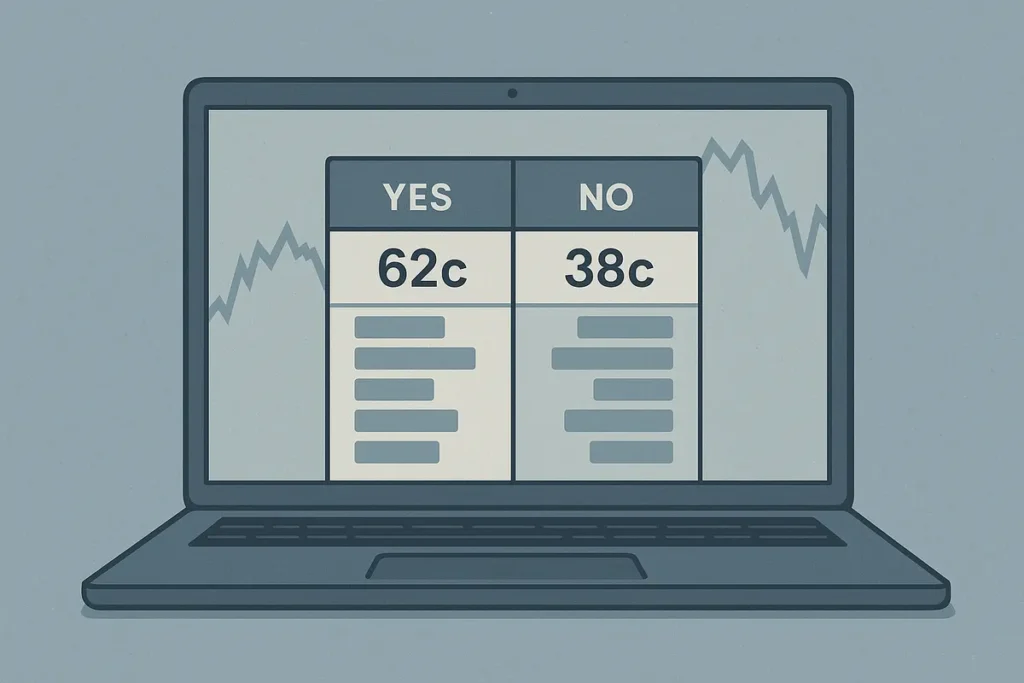
A US Senate race is still being counted, and a contract on one candidate winning is changing hands at 62 cents. Twenty minutes later, after a county with a big mail-ballot batch reports, the same contract trades at 81 cents. Nobody changed the odds. Buyers and sellers did, one order at a time.
That is prediction markets explained in a single scene. A prediction market is a trading venue where people buy and sell contracts tied to whether a specific event happens: who wins a governor’s race, whether a central bank cuts rates, whether a film crosses a box-office number. On the platforms driving this year’s surge in election-season trading, Polymarket and Kalshi among them, those contracts are typically priced between 1 and 99 cents and settle at either 100 cents (the event happened) or zero (it didn’t).
Here is my thesis, and the rest of this article defends it: the mechanics of event trading really are different from placing a bet at a sportsbook, and those differences matter for how prices behave and how you can manage a position. But the risk is not different. You can lose everything you put in. Anyone telling you prediction markets are “investing, not gambling” is selling you a label, not a lower risk of loss.
How prediction markets work: price discovery instead of fixed odds
A sportsbook quotes you a price, takes your money, and carries the risk. It builds a margin into the line so the implied probabilities across all outcomes add up to more than 100%. Offer 1.45 on one side (69% implied) and 2.50 on the other (40% implied) and you have roughly a 9% overround baked in. That is the house edge, and it applies the moment you accept the price.
A prediction market does something closer to what a stock exchange does. It matches your order against another participant’s order. If YES trades at 62 cents, NO is available around 38 cents, and the two sides sum to about 100 rather than 109. The platform’s revenue comes from trading or settlement fees rather than from a margin buried in the odds. The price itself is the crowd’s current estimate of probability, and it moves whenever someone is willing to pay up or sell down.
Market makers and liquidity
Prices only move smoothly if someone is always willing to quote both sides. That job falls to market makers, who post simultaneous buy and sell orders and earn the difference. Liquidity, meaning how much size you can trade without moving the price, is the single most important quality difference between one event market and another. A US presidential contract might absorb large orders with barely a flicker. A contract on a county commissioner race might have a few hundred dollars on the book, in which case your own order becomes the news.
Order books and bid-ask spreads
Open the order book and you see resting bids (what buyers will pay) and asks (what sellers want). The gap between the best bid and best ask is the bid-ask spread, and it is your real cost of entry and exit. A market quoted 61/63 costs you two cents to round-trip before anything happens. A market quoted 55/70 costs fifteen. Thin books also create arbitrage gaps, where the same event is priced differently across platforms until traders close the difference. Those gaps exist precisely because liquidity is unevenly spread.
Event trading vs betting: what actually changes
Direct answer: with a bet, you lock a payout and wait. With an event contract, you own a position whose value floats until the event resolves, and you can usually sell it before then. Everything else follows from that.
Payout structures
Buy a contract at 40 cents and hold to a YES resolution and you receive 100 cents: 60 cents of profit on 40 cents at risk, a 150% return. A losing contract is worth zero. Functionally that resembles a binary option, and your effective odds are set by the price you paid rather than by a number a bookmaker chose. A sportsbook, by contrast, hands you a fixed return that never changes once the slip is confirmed.
Exit strategies
This is the genuine structural advantage. Suppose you bought at 40 cents, a debate goes well, and the market reprices to 70. You can sell into that bid and bank 30 cents per contract without ever learning the outcome. Or the story turns against you, the price drops to 25, and you sell to stop the bleeding rather than watch a total loss. Cash-out features exist at some sportsbooks, but they are priced by the operator on its own terms. On a prediction market you exit at whatever the order book offers, which is better when liquidity is deep and worse when it has dried up.
Risk management
Being able to exit invites more trading, and more trading means more spread paid and more chances to act on emotion. A bettor who places one wager has one decision to regret. A trader who can enter and exit twenty times a night has twenty. Scaling into positions, capping exposure per market, and deciding your exit price before you buy matter more here than they do on a betting slip. If you have read our guides on bankroll management, the same discipline applies with extra force.
| Feature | Prediction market contract | Sportsbook bet |
|---|---|---|
| Who sets the price | Other traders via the order book | The operator |
| Where the cost sits | Bid-ask spread plus platform fees | Margin built into the odds |
| Implied probabilities | YES + NO sum near 100% | Sum above 100% (overround) |
| Payout | 100 cents per winning contract, 0 if it loses | Fixed return agreed at placement |
| Exit before resolution | Sell at the market price, subject to liquidity | Only if the operator offers a cash-out |
| Main practical risk | Thin books, volatility, platform risk | Fixed house edge, limits on winning accounts |
How accurate are prediction market odds?
Reasonably accurate in liquid markets, and unreliable in thin ones. Kalshi has pointed to its own research showing strong calibration, with events priced near 60% happening close to 60% of the time, and argues that anyone trying to push a price away from reality gets picked off by traders taking the other side. Academic work going back to the Iowa Electronic Markets has generally found that market prices hold up well against contemporaneous polling. Both claims are worth taking seriously, and both come with conditions.
The conditions are volume and incentive. Prediction market odds are money-weighted opinion, not a survey. When plenty of capital is engaged and both sides can trade freely, prices tend to aggregate information efficiently. When the market is quiet, a single motivated buyer can hold a price at a level nobody genuinely believes. 2025 offered examples of both: markets heavily favoured a losing candidate in a Wisconsin gubernatorial primary, though the polls were badly wrong in that race too.
One more reason prediction market prices differ from sportsbook numbers: a sportsbook line is shaped by the need to balance the book and protect a margin, while a contract price also reflects fees and the cost of having capital tied up until resolution. Neither number is a pure probability. The market price is usually the cleaner of the two, but “cleaner” is not “correct”.
Where retail participants get hurt
- Liquidity risk. The exit you counted on may not exist. In a thin market, selling 500 contracts can move the price against you by several cents before the order fills.
- Volatility. Event prices jump on headlines, leaks and partial vote counts. A position that is comfortably profitable at 9 p.m. can be worthless by 11.
- Information asymmetry. Somebody always knows more. US platforms operate insider-trading rules under federal law, and Kalshi disclosed on 31 August that it suspended and fined a North Carolina congressional candidate for three years for trading on her own race. Enforcement exists, but it arrives after the fact.
- Platform and counterparty risk. Your money sits with the venue, sometimes in crypto, sometimes offshore. Withdrawal delays, account restrictions and outright blocks are real failure modes.
- Regulatory risk. Several US states are trying to shut these platforms down as unlicensed casinos, and election administrators have raised concerns about financial incentives attaching themselves to vote counting. Legal fights can freeze markets mid-position.
- Emotional trading. A live price on a subject you feel strongly about is a trap. Political conviction is not an edge, and the ability to trade all night is not an advantage.
Legal considerations for Indian traders
Educational summary, not legal or tax advice. Get a professional opinion before you act.
Event contracts are not a recognised instrument on Indian exchanges, so none of the familiar investor protections apply. Gambling is largely a state subject in India, and in 2025 Parliament also passed central legislation restricting online real-money gaming services and their promotion, which puts offshore event-trading platforms in a difficult position for Indian residents. The platforms themselves are not licensed here, which means no local recourse if funds are frozen.
Funding is the second obstacle. The RBI’s Liberalised Remittance Scheme does not permit remittances for lottery or gambling-type activity, and routing money through crypto to sidestep that creates its own compliance exposure. On tax, winnings from online games are taxed in India at a flat rate with TDS on net winnings and no set-off of losses, while crypto-denominated gains fall under the separate virtual digital asset rules. Offshore platforms will not deduct anything on your behalf, so the reporting burden is entirely yours.
Frequently asked questions
Are prediction markets gambling?
Operators argue no, comparing event contracts to hedging election risk in the stock market, and some analysts accept that framing. Regulators in several US states argue yes. Functionally, you are risking money on an uncertain outcome with fees against you, so treat it with the same caution you would apply to betting regardless of the label.
How do prediction markets set prices?
Through matched orders in an order book. The last traded price is the crowd’s current probability estimate, and market makers keep both sides quotable in exchange for the spread.
Can I lose more than I put in?
On a straightforward long contract position, no: the maximum loss is what you paid, since a contract can only fall to zero. That is still a 100% loss of the stake.
If you do engage with any event or betting market, set a deposit and loss limit first, use the platform’s self-exclusion and cool-off tools, and never fund a position with money you need. Help is available through Indian support services if gambling stops feeling like a choice.