

Jackpots of $100, and a $46 billion aftermath
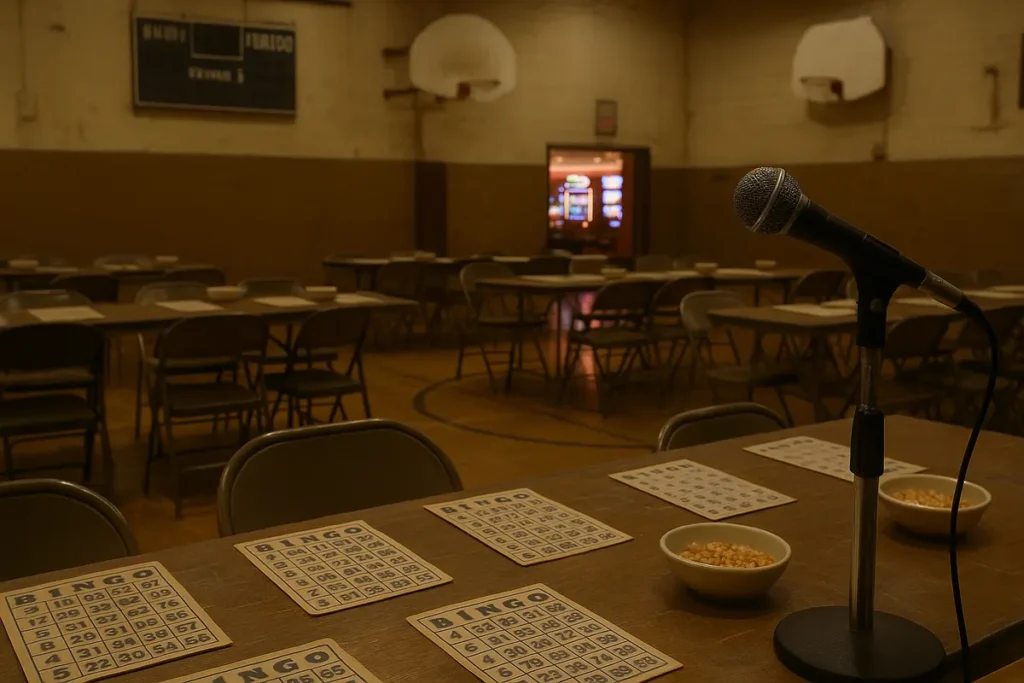
In 1976, two women, Sandra Brehmer and Alma Webster, started a bingo game in a gymnasium on the Oneida Tribe’s reservation, in a two-county stretch just west of Green Bay, Wisconsin. Players covered their squares with corn kernels and chips. Turnout began at 50 people or fewer. Jackpots eventually reached the dizzying height of $100.
That gymnasium is the honest starting point for the history of tribal gaming in the United States, an industry reported at more than $46 billion in 2025. And here is the part that gets lost when people tell this story: the industry was not built on slot machines, capital or casino design. It was built on a legal distinction that a bingo caller in Wisconsin had no reason to know existed, the difference between a state regulating gambling and a state prohibiting it.
Victor Rocha, conference chairman at the Indian Gaming Association, puts the origin point plainly: “When you open these little bingo halls and you’re getting money … it brings the tribes closer to the American dream. Bingo was that first crack in the door that day.”
Why bingo, and why tribes ran it first
Bingo was not chosen because it was glamorous. It was chosen because it was cheap and it was already respectable. A room, a caller, paper cards, a prize pot. No dealers to train, no machines to buy, no vault. For decades it had been the domain of Catholic churches and volunteer fire halls, which is precisely why it was legal, in some regulated form, in most states. That respectability later became the legal lever.
The motive was revenue for government services. Seminole Tribe Chairman Marcellus B. Osceola Jr. described the calculation his tribe faced when it opened bingo in Florida in 1979: “Like many Indian tribes, the Seminoles were seeking new sources of revenue to provide important needed services for our tribal members. Health care, education, housing, senior services, and other needs were on the list and it was our hope that bingo games could help to fund them.”
Growth at Oneida followed the pattern you would expect from any product that finds its market. Attendance doubled, then filled the room. According to Taryn E. Webster, CEO of Oneida Casino Hotel, and Jessalyn Harvath, the property’s assistant general manager, the operation “steadily grew to setting the entire gymnasium floor with tables and chairs and a sound system and eventually electronic boards on the walls.” The escalation from paper cards to electronic boards inside a single decade tells you how quickly demand outran the format.
It also drew attention. “The local jurisdictions opposed and threatened to shut us down, but we persisted and battled in the courts and eventually won,” Webster and Harvath said.
The legal hinge: regulate or prohibit
Everything about tribal gaming origins turns on a 1953 statute that had nothing to do with gambling. Public Law 280 transferred criminal jurisdiction over tribal lands to certain states, Florida and Wisconsin among them. States read that as authority to enforce their gambling rules on reservations. Tribes read it more narrowly: PL 280 handed over criminal law, not the state’s general regulatory apparatus.
Florida tested it. In Seminole Tribe v. Butterworth, named for Broward County sheriff Robert Butterworth, the state moved to shut down or cap the tribe’s bingo, arguing that unregulated games invited organised crime and that the state could not be shut out of oversight. The tribe’s answer was that Florida did not ban bingo at all, it licensed and limited it for charities. A law that permits an activity under conditions is regulatory, not prohibitory, and PL 280 gave the state no hook. The federal courts agreed in 1981.
The same year, Oneida Indians of Wisconsin v. State of Wisconsin went the tribe’s way, with the court noting that the Indian sovereignty doctrine matters “because it provides a backdrop against which the applicable treaties and federal statutes must be read.” Attempts to ban tribal bingo in Wisconsin collapsed.
Two district-level wins are not an industry. What turned them into one was the Supreme Court’s 1987 decision in California v. Cabazon Band of Mission Indians, which applied the regulate-versus-prohibit logic nationally. California ran a lottery and allowed charitable bingo, so it could hardly claim gambling was against its public policy. Tribes across the country suddenly had a federal rule they could build on, and they did, fast.
IGRA gaming: the 1988 bargain that produced the casinos
Congress responded within a year. The Indian Gaming Regulatory Act of 1988 was a compromise, and reading it as a gift to tribes misses the trade. Tribes got legal certainty and a federal framework. States got a seat at the table for the most profitable games. IGRA also created the National Indian Gaming Commission and split games into three classes, which is still the single most useful thing to understand about the sector.
| Class | What it covers | Who regulates it | Approval needed |
|---|---|---|---|
| Class I | Traditional and social games tied to tribal ceremonies, minimal prizes | The tribe alone | None |
| Class II | Bingo and bingo-based electronic games, plus certain non-banked card games | Tribe, with National Indian Gaming Commission oversight | No state compact required |
| Class III | Slot machines, house-banked table games, most sports betting | Tribe, state and federal government under a compact | Tribal-state compact, negotiated in good faith and federally approved |
IGRA also restricts what the money can do. Net gaming revenue has to go to tribal government operations, member welfare, economic development, charitable donations, or to help fund local government agencies. That constraint is why tribal gaming reads less like a casino business and more like a public finance instrument, and why comparisons to commercial operators tend to mislead.
Bingo never left the building
The most underappreciated legacy of those bingo halls is sitting on casino floors right now. When a tribe cannot reach a Class III compact with its state, or does not want one, it can still offer Class II. So vendors engineered electronic bingo, machines with spinning reels, sound and a familiar cabinet, where the outcome is actually determined by a linked bingo game played against other participants. The reels are a display layer over a bingo draw.
For players, the practical differences matter. Class II games are competitive rather than purely house-versus-player, the return to player is set by the prize structure of the bingo game, and the mechanics look like slots without being slots. The house still holds a built-in mathematical edge, exactly as it does on a Class III machine. The format survives because a 1981 argument about charity bingo halls drew the line where it did.
What this history means for iGaming now
The jurisdictional question that started in a gymnasium is the same one online gambling keeps running into: where, legally, does a wager take place?
After the Supreme Court struck down the federal ban on state sports betting in 2018, that question got urgent. Florida’s 2021 compact with the Seminole Tribe answered it by treating a mobile bet placed anywhere in the state as occurring where the servers sit, on tribal land, the so-called hub-and-spoke model. It is the direct descendant of Butterworth: the fight is over whose law governs the transaction, not over whether people want to bet.
Three consequences worth holding onto if you follow the sector:
- Exclusivity shapes the online map. In states where compacts grant tribes exclusive rights to casino-style gaming, online casino bills tend to stall, because legalising iGaming can trigger or breach those exclusivity terms. Where US online casino is legal is as much a story about tribal compacts as about legislative appetite.
- Partnership is often the only door. For commercial operators, market entry in compact states frequently means a deal with a tribe rather than a licence from a regulator. Tribes are counterparties, not just incumbents, and several now run their own digital brands.
- Class II is a live technology market. Bingo-based machine design remains a real engineering and legal speciality, not a historical footnote.
The lesson from the whole arc is unglamorous and durable. A $46 billion industry grew out of corn kernels and $100 jackpots because a handful of tribes were willing to litigate a narrow point of law for years. Regulatory structure, not product, decided who got to build casinos in America.
Quick answers
When did tribal gaming start in the US?
Modern tribal gaming traces to 1976, when the Oneida Tribe in Wisconsin opened a bingo game in a reservation gymnasium. The Seminole Tribe of Florida followed in 1979. Both faced state efforts to close them down and won in federal court in 1981.
What is IGRA gaming?
IGRA is the Indian Gaming Regulatory Act of 1988. It created the National Indian Gaming Commission, sorted games into Classes I, II and III, and required a tribal-state compact before a tribe can offer Class III games such as slot machines and house-banked table games.
Why were bingo halls so important to Native American gaming history?
Because most states licensed charitable bingo rather than banning it. That made state bingo laws regulatory instead of prohibitory, which meant states lacked authority to enforce them on tribal land. The courts built on that distinction all the way to the 1987 Cabazon decision.
Do tribes pay tax on gaming revenue?
Tribal governments are not subject to federal income tax on their gaming revenue, but per capita distributions to individual members are taxable to those members. Many compacts also include revenue sharing with the state, typically in exchange for exclusivity.
If you gamble, whether in a tribal casino, on a Class II machine or online, treat it as paid entertainment with a house edge rather than income, set deposit and time limits before you start, and use self-exclusion or cool-off tools if play stops feeling like a choice.